Joint Opening and Loosening DVD, me - Brian C. Allen, my business - OMHS, qigong, t'ai chi

Joint Opening and Loosening Exercises – Upcoming DVD Release

I am currently working on a video project currently that will result in an instructional DVD for joint opening and loosening exercises as taught in my qìgōng (氣功) and tàijí (t’ai chi -太極) classes. I have finished all of the filming, almost 2 hours of footage, but still need to do much editing. The target price is set at $20. I want it to keep it inexpensive so that it is accessible to more people.

The DVD has its own Facebook page HERE.

It is Qìgōng.

The joint opening and loosening exercise set makes for an excellent daily qìgōng routine. It is relatively simple to perform and only takes between 10 to 15 minutes to complete depending on pace. By opening and loosening the joints, you are also helping to open the acupuncture channels in the body, thereby aiding in the circulation of your qì and blood. There is a saying in China that roughly translates to “a used door hinge never rots.” Regular practice of this set while working on becoming more correct in how you do the set will bring you many worthwhile benefits.

It is also Jīběngōng (基本功).

Jīběngōng translates roughly as basic exercises. This set of joint opening and loosening exercises serves as a set of basic training exercises for developing foundational skills in tàijí. Having open and loose joints is a requirement in tàijí, and in my opinion is an important part of the “sinking” that is also part of tàijí. Doing this set regularly and correctly will help build part of your martial arts foundation.

The DVD consists of 4 parts, not counting opening and closing remarks.

Part 1 of the DVD is a demonstration of the set of exercises for the purpose of following along in order to memorize the sequence or to serve as a reference. I have uploaded part 1 to YouTube as a freebie, and it can be found here:

If you have not yet subscribed to my YouTube channel so that you never miss a new video of mine,  please click here to subscribe.

Part 2 of the DVD consists of a breakdown of how to do the individual movements. There is much more to it than meets the eye. Based on appearances, this is a simple set of range of motion exercises for the major joints of the body. If done conventionally, this set has value in that is keeps you moving and able to maintain range of motion into your old age if practiced carefully and daily. However, I do these movements in a specific manner driven by awareness. Done this way, this set is a vehicle for discovery of what it means for a joint to be open and how to maintain that openness. Having open joints, in my opinion, is not only a basic requirement for internal martial arts and for allowing forces to pass through the body, but it is also an important part of good qìgōng, allowing for better circulation of the and blood. I feel that if physical forces can get stuck in your body at certain points, then the and blood flow can be negatively affected at those points as well.

Learning the material in this part of the DVD is very important, otherwise you will not get beyond the conventional, and you will miss out on all the additional benefits to be had. It is difficult to explain in writing about the “how to,” but there are two general things to keep in mind while doing the set. 1) You must relaxedly extend outwards so it is as if the body is expanded in a non-forced manner. The wording is a bit weird when you consider that there are certain angles involved with some of the movements, but I hope you get the drift of that idea. It is much clearer in the video instruction. 2) Care must be taken to not involve any muscles / parts of the body that are not actually necessary for the movements. Use only enough to allow the movements to happen. You would be surprised at how much unnecessary movement you do all day long without even realizing it, much of which makes you very non efficient.

It is also important to note that you will be able to learn much of what I explain by watching, thoroughly contemplating, and practicing the movements as indicated in part 2. However, hands-on instruction is the best method for learning this type of material. If you do decide to practice this on your own, you can always schedule a private lesson with me for corrections and pointers for improvement.

Part 3 of the DVD is also very important for learning this set correctly. It contains methods for testing whether or not you are doing the movements correctly. This requires another person to administer light physical challenges for you to overcome while performing the movements of the set. If you become impeded by your tester, then you have become “stuck,” which indicates that the joint(s) being tested are not really open and loose. Having physical force get stuck in your body like this indicates that your flow has also stagnated. There are degrees of being stuck, and it is typical for beginners to be very stuck. As you improve, you may be partially stuck, but the goal is to not be stuck at all. Therefore, this testing is a very important part of gauging your progress. People can easily fool themselves with practices like this, so a testing method like this adds accountability to the process. The tests that I show in the DVD are not the only tests. You can come up with your own tests once you get the idea of the function of the tests and how they are done.

Part 4 of the DVD has me demonstrating what having open and loose joints could possibly do in self-defense situations. When a person comes at you using force, and you have trained yourself so those forces do not get stuck within you, then your movements are much freer than they would be without that training. This section is not meant to teach self-defense or to be comprehensive. It is only demonstrations of a few scenarios so you get the idea of the potential uses.

Overall, this will be a good DVD for beginners or for those who want to take a look at these practices of qìgōng and tàijí beyond the superficial and conventionally apparent. Also, you will be able to learn a good amount of what I am trying to teach just by your diligence. I know many think that learning internal practices from video is not possible, and I have kept that in mind. The basics that I show are within your grasp. A release date has not been set yet, but I will keep you updated with posts here about it. After the initial round of editing, I will soon be posting a sample trailer of the DVD so that you can get a sense of its content.

my business - OMHS, qigong, t'ai chi

Can I try a class for free? Can I pay by the class?

As a qìgōng (氣功) and tàijí (t’ai chi -太極) instructor, I get these two questions frequently. The answers are simple. Yes. No. However, there is more to the answers than meets the ear. Let me explain.

Can I try a class for free?

When people ask me this question, I always think the same thing, but I do say, “Yes.” So, what is it that I am thinking? Well, there are two main thoughts that go through my head.

  1. Would you go to any other professional or business and ask the same? Would you go to a dentist and say, “Could you just clean one tooth for free so I can try it out?” Would you go to a restaurant and say, “Could I try out an entrée for free so I know if I like it or not?” I realize that people want to be satisfied when they are paying for something. I completely understand. However, people sell products and services, and often the only way to find out your level of satisfaction is to commit. There are exceptions, of course, but we are all trying to make a living. I am trying to run a business, but I do want your business. So, I keep these thoughts to myself, and I say, “Sure, when would you like to get started?”

  2. This is not a typical exercise class. This is not like a step class or an aerobics class where you show up, follow along with what the teacher does for an hour, put in your time, go home, and do not think about it or do again until next class where you once again mindlessly follow your teacher’s exercise routine. Furthermore, there is much more to the movements than meets the eye. You may see me raise my arms, but if you were to try to duplicate that, you would raise your arms up in a similar looking fashion, but you would not know how I was raising my arms. Most of what goes on in the classes is about learning a new way to move. Easily for the first 6 weeks or so, most students are just trying to grasp the concept that there is such a thing as a different way to use one’s body. Sure, they are learning the choreography of movements, but they still have no clue otherwise. It is frustrating for them. Memorizing movements can be frustrating. Facing your body’s bad and inefficient habits can be frustrating and challenging to your ego. Trying to learn a new way to use your body can be frustrating. Students are typically frustrated for many months during the initial stages of learning. Those that have faith in the process will stick with it despite those initial frustrations, and they will start to learn and benefit from the process. However, there is not much of anything that I can teach you that you can learn in one free class session during a normal class with other students in the class that also need my attention and are paying for it that will let you get a feel for what the total class experience is really like. Sure, you can get a feel for my teaching mannerisms, the general nature of the other students, the training area itself, etc., but really you cannot effectively judge at all as a beginner whether or not you will like it because you will actually have no idea at all what “it” really is. It takes time, dedication, and practice.

Can I pay by the class?

Again, when asked this question, I usually have specific things going through my mind. The short answer is, “No.” My current rates can be found here.  I have two main lines of thought in giving this answer, and I usually give these explanations for those still interested in what I have to say after being disappointed and bothered by my answer of “No.”

  1. Class payments are tuition. As with other tuitions, you pay for the class material. It is up to you to show up and learn. You payments basically fund me to teach. I will show up and will be here teaching. You have to decide if you are really interested in learning, and you have to make the commitment to do so. If you signed up for a college course, you would not be paying only if you showed up to the classroom and not be paying if you did not. Again, I am trying to run a business. I do want your business, and I want commitment from you, not just for my business’s sake, but for your own benefit as well. This leads us into my closely related second thought about this.

  2. As I mentioned in #2 above in the section about trying a class for free, this is not a typical exercise class. This is not like a step class or an aerobics class where you show up, follow along with what the teacher does for an hour, put in your time, go home, and do not think about it or do again until next class where you once again mindlessly follow your teacher’s exercise routine. This is not the kind of class that will give you the expected benefits just from following along in class and doing nothing else with the material outside of class. This is not putting in your exercise time twice a week to increase your level of physical fitness. I am not saying that it will not increase your physical fitness if that is all you do. It will. You will get a work-out from class, but that is not the end goal. This is so much more than just exercise, and there is a huge learning process involved. In class, I am there to teach you, and I will have to teach you the same things over and over again until you start to understand. This is done in the context of choreographed movements which from an outside perspective looks like exercise. At home, preferably on a daily basis, you must practice not only the choreography, but also what I was trying to get you to learn. In your following class, I do check your choreography, which is easily corrected, but I am more interested in if you learned what was being taught. Having an attitude or mindset that you will show up every now and then, paying by the class, when it is convenient for you or when you do not have anything else better to do, will not get you anywhere. You will be wasting your own time and money, and you will be wasting the time of others in the class, as beginner level students require much much more of my attention during class time than those who have already started to grasp what it is that is really going on. If you are an “every now and thenner” you will always be a beginner. If this is what you really want, your money and time will be better spent purchasing a DVD with which you can just follow along.

I hope you now have an understanding of my reasoning behind the answers to those two questions. In the classes I teach, there is a much to be learned. If you have no previous experience, I recommend that you do some research into the topics of qìgōng and tàijí (t’ai chi) to first see if those are things that you think you are interested in enough in order to make a commitment. If so, then just get in touch with me for the class schedule and to let me know when you want to try out one class for free. I look forward to working with you on your journey to a new and better you.

qigong, t'ai chi

Huà (化) – Neutralization

I am a member of a Facebook group called The Kwoon. In September 2013, I suggested that The Kwoon have a monthly video project wherein a topic is picked and members submit their videos on the topic. My hopes were that current and future members of The Kwoon would be able to search a topic and find not only discussion, but also video explorations of these topics, representing many points of view.

October’s topic was Huà (化), often translated as neutralization, and refers to a particular skill or phenomenon in martial arts whereby an attack is rendered neutral.

My video submission gives a brief look at huà. As is often the case, I demonstrate slowly on purpose in order to more clearly try to show what is going on and also to show that I am not just using speed and conventional strength in order to do the tasks within the demonstrations.

In the taijiquan (T’ai Chi) that I do, I arrange my body, especially my joints, in such a way that forces applied to my body flow through my body rather than getting stuck somewhere in my body. If forces were to get stuck or land in my joints, my movements would not be free, and my structure, balance, and power base would be affected by those forces. By allowing the forces to pass through me, I avoid this.

I realize that in Chen style taiji, huà is a specific method involving part of a curve, however, here I am just referring to making the other person’s power not impede what I am doing.

I hope you enjoy the video, and please subscribe to my YouTube channel. Thank you for watching.

Level 1, t'ai chi, t'ai chi handouts

Zheng Manqing’s (鄭曼青) 37-Posture Simplified Yang Style T’ai Chi Form

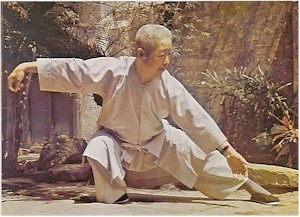
Zheng Manqing in snake creeps down.
Zheng Manqing performs snake creeps down

I have compiled a list of the names of the postures of Zheng Manqing’s 37-Posture Simplified Yang Style T’ai Chi form. The names are listed in Hanzi, in Pinyin (with tones), and in English. In order to preserve the formatting of the columns and the Chinese characters, I have provided a link to a PDF file.

This is a Level I handout my T’ai Chi class.

click HERE to download the PDF file